copyright

All stories and photos on this site, Earthy Reporter, are the property of Carola C. Reuben and cannot be used elsewhere without prior written permission from Carola C. Reuben. Just ask. I will probably say yes.

Showing posts with label Alternative Community in Chapada dos Guimaraes. Show all posts

Monday, December 26, 2011

Part 3, Chapada Revisited: Aging City Dropouts Leave Deep Imprints in Brazilian Wild West

Jaguar, Heloisa/copyright 2011
Sergio Vega/ copyright 2011


Copyright 2011 Carola C. Reuben

Plastic frogs pose in bikinis in downtown Chapada dos Guimaraes in Brazil’s wild west. Imitations of Chapada’s wildlife fill its shops after a soap opera made the area famous.
Chapada’s scenery was on TV for months as a backdrop for “Ana Lightening and Ze Thunder” (Ana Raio e Ze Trovao). Since soap operas run on prime time in Brazil, millions of people saw Chapada’s natural wonders.
That was about 21 years ago, and Moby then said, “aha…let’s start an eco-tourism agency,” according to Lui, Moby’s son. Moby, a teacher and historian, mapped attractions in the wilderness, researched Chapada history, and opened Eco-Turismo Cultural.
Eco-tourism pioneer Moby was among the first youths who arrived in the early 1980s seeking an alternative lifestyle.

Copyright 2011 Carola C. Reuben
His son Lui grew up mostly in Sao Paulo with his mother while spending vacations with his father in Chapada. A few years ago, Moby died of cancer in his mid forties; Lui then left college and moved to Chapada with his mother and sister “to continue his father’s work.”
So, Eco-Turismo Cultural remains in downtown Chapada alongside tourist magnets of other stripes, including the gift shop, Mary Variedades e Presentes (photo below), and the plastic jaguar in the town square (photo, top right.)


Restaurants also lure tourists with many choices, like Oishi-Sushi, Delicious Potato, Don Quixote’s tapas, and Chale da Fondue. The fondue restaurant offers imported trout in spite of the abundance of fish from local rivers.

In that mix of foreign flavors, a city dropout of the 1980s provides tastes rooted in nature.
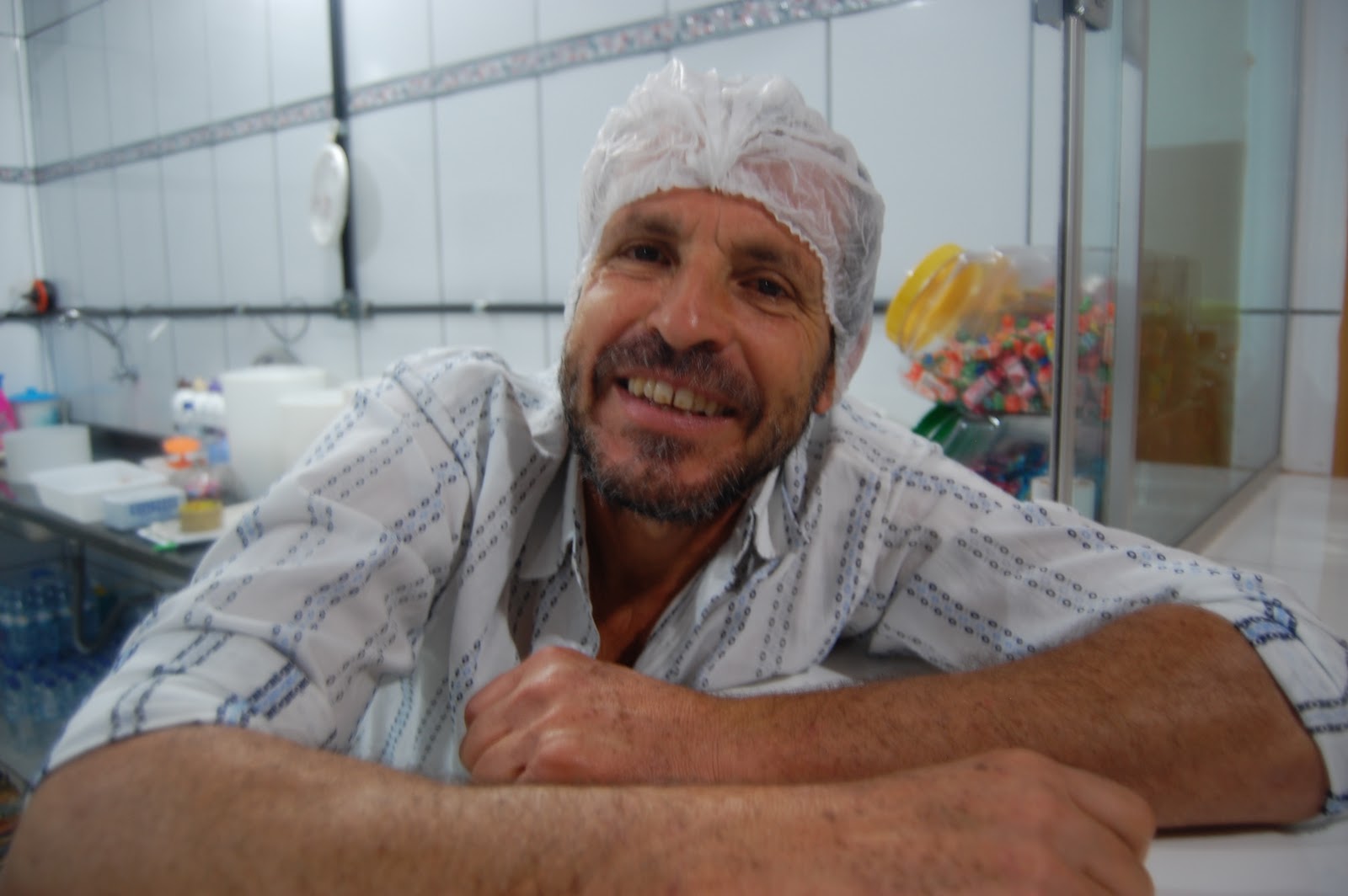
Mazinho, 51, (photo above, right) makes popsicles and ice cream with real vegetables and fruits, including coconut, ginger, corn, guava, acai, caju, pequi. 
Copyright 2011 Carola C. Reuben

The natural treats now sell in his large ice cream parlor, Sorvetes Mazinho, but at first they were sold from a cart on the street.
Mazinho (whose real name is Vilmar) used to make crafts for a living. When that occupation literally gave him a pain in the neck, 11 years ago he started producing alternative popsicles.
Other businesses reflect the town’s counter culture. A regression therapy clinic focuses on patients’ past lives. At the Organic Vegetable Garden, workers pluck greens out of the ground as shoppers select them.
Meanwhile, some members of a younger generation give continuity to their parents’ values. Lotus, for one, was born in Chapada, but after her parents separated, she went to live with her father in Sao Paulo at the age of 9. Eventually, my niece Lotus bore a child, went to college, and worked as a teacher in the big city.
However, she kept hearing the call of the wild, and finally, in 2010 when she was 27 she returned to live in Chapada.
Her earth-saving activities include participating in a reforestation project and teaching organic vegetable gardening (photo below, right). She is also busy protesting the construction of Belo Monte, a nearby hydroelectric plant that will displace Indians.
The Jamaca valley, where Lotus was born, remains green, and there people still pursue nature-related projects.

For instance, from a thick fog Sergio suddenly emerges from the woods. He wears a camouflage shirt and leggings for protection from snakes as his camera focuses on wild animals (photo top, left). Sergio Vega, a photography professor in Gainesville, FL, USA and a native of Argentina, has been taking trips to the region for 15 years.

As the past connects with the present in other ways, seeds planted along the road by my brother Mike nearly 30 years ago have turned into a public orchard with avocados, mangos, guavas, lemons, limes, jaca, caju, genipapo.
Also on that road, Jon Kempsey, a native of UK, organizes wilderness education classes attended mostly by US youths. He is a program coordinator for the US-based National Outdoor Leadership School (NOLS).
Jon (photo above, left ) explains that he enjoys motivating future generations to preserve the Earth. He landed in an area with people who have similar values, he says. “Here, we can establish connections with people of our own mind.”
Story and photos by Carola C. Reuben.
Copyright 2011, Carola C. Reuben, Earthy Reporter
Part 3 of a 3 Part Story.
earthyreporter@aol.com

Saturday, December 3, 2011

Part 2, Chapada Revisited: Aging City Dropouts Blend with Development in Brazilian Wild West

The children with plant names were fidgeting around their home in Chapada dos Guimaraes when I emerged from the thick greenery.
It was 1991; my nephew, Haloa (whose name means Field of Flowers in the native Indian language Tupi-Guarani), was then 2. He was outside splattering mud up to his neck. Inside the house, my niece, Iuca, (Manioc Root in Spanish), 5, was tugging at her mother’s skirt. My niece, Lotus, 8, ran to hug me.
Cida’s other children, not my nephews, were Ginseng, then 12, and the howling infant Caiubi (Blue Leaves in Tupi-Guarani.)
In spite of the commotion, their mother, Cida, seemed relaxed. My arrival after three years was a surprise, but she greeted me casually, “Oi, tudo bem?” (Hi…everything all right ?)
Cida bore three more children during the next 10 years, Radharani ( wife of Krishna, Completeness in Sanskrit ), Iasmim (Jasmine), and Hermano (Brother in Spanish). She would have had nine children, but she lost one when a snake bit her during pregnancy. So, she only had eight.

Cida makes music with grandchild Isabela. Behind them: Radharani
 The 1991 visit was my third in six years. Usually, I managed to leave the US in January during those years when I was publisher of Mundo Hispanico, Atlanta’s Hispanic community newspaper.
Then I stopped visiting Chapada. My brother, Mike, had separated from Cida (before 1991), and their three children eventually went to live with him and go to school in Sao Paulo.
Now after more than 20 years, I finally visited Chapada. Cida, 56 (photo, top right), still lives in the small wooden house built by Mike about 30 years ago when he was 18.
Fruit trees fertilized with his children’s placenta still grow in the front yard near woods full of monkeys and coatis. A river flows about half a kilometer behind the house. Using buckets of water he fetched from that river, Mike had delivered two of his children.
As always, Cida (short for Maria Aparecida ) cooks by wood fire. She has had running water for many years, and electricity became available in her area several years ago. A sign that says “seamstress” and another that advertises “whole grain bread baked by wood fire” hang on her fence by the deep green road ( see photo, previous post).
After relationships with the three fathers of her children, Cida says she chooses to be alone, with God only. She attends a group that uses mantras and prayers as “a way to go inside yourself.” Her spiritual practice seems to mix vegetarianism, reincarnation, Jesus, and more.
Some of her “alternative community” neighbors from the 1980s continue to live on her road, including Jorge in the Indian hut (see previous post). Nearby, another old-timer, Helio, still spends his nights in a hammock on the porch of his brick house (photo below). Since he sleeps outdoors, he says, “I don’t even know why I have a house.”
His rustic kitchen has a view of the woods (photo above, Helio in foreground ); there he talks about running away from home about 30 years ago the day he was scheduled to register for college in the city of Recife.
Now he makes a good living as a specialized guide who leads people to wild animals in the nearby Pantanal, one of the world’s largest wetlands.
He complains about deforestation in Chapada. Vacation homes have been sprouting around him for two decades. Less than a mile away, the high walls of gated communities, Condominio Jamaca Village I and II, jut out of the woods like an urban nightmare.
Another city dropout from his era, Mario, keeps a home in Chapada, made of hand-made bricks. However, during recent years he has been living in the wilder west of Vila Bela da Santissima Trindadade near the Bolivian border.
When Mario, now 51, arrived in Chapada about 30 years ago, he stayed very close to the animals he was photographing. He lived in a one-room hut deep inside the woods near the waterfall on his property (photo, top of post, right). It serves as the neighborhood pool.
Now an established photographer, Mario Friedlander posts wlidlife and scenery shots on his facebook page. He also puts links for petitions to save the Amazon.
During my visit to Chapada, Mario was in town taking pictures of Chapada’s winter music festival for the municipal government, which now presides over a population of more than 17,000.
In that municipality, the dropouts of the 1980s have left  imprints (see upcoming story, Part 3). However, Mario insists with a tone of utter disgust: “This has turned into a place for the bourgeois.”
Story and photos by Carola C. Reuben, Earthy Reporter, copyright 2011
TO BE CONTINUED SOON...PART 2 OF A 3 PART STORY
earthyreporter@aol.com

Sunday, November 13, 2011

Part 1, Chapada Revisited: Aging City Dropouts Blend with Eco-Tourism in Brazilian Wild West


Youths escaping from urban lifestyles arrived in Chapada dos Guimaraes long before the slogan, Mecca of Eco-tourism, appeared on the town’s welcome sign.

Back in the 1980s before “eco-tourism” became a common term, I watched the young settlers celebrating nature. They bathed naked in waterfalls and smoked pot in the wilderness. Some planted fruit trees and organic vegetables. Some made whole grain bread and babies.
They found paradise in Brazil’s wild west in a region of steep cliffs at the edge of a plateau in the state of Mato Grosso do Sul.
Some of the youths I met in the 1980s still live in Chapada. Now they are 50ish or older, and many make a living from the development they reject.
Jorge, who stayed in Chapada, once tried to stop development by darting out naked on the dirt road in front of his property whenever he spotted land buyers. He wanted to scare them away, but people from the nearby city of Cuiaba kept building vacation homes.
Jorge’s green road in the Jamaca valley (photo, left ) is no longer the exclusive domain of the “alternative” community. However, his lifestyle remains much the same, though now he complains bitterly about having arthritis.
Jorge, 56, still lives in the Indian hut he built (photo bottom of post.) The blood of three races runs in his veins, but he says he finds refuge mostly in his Indian heritage. He frequently visits the Xavantes, one of the tribes in the region. Like the Xavantes, he wears several inches of wood in each ear; the Indians use the pieces to dream and to make predictions.
Jorge abandoned an urban lifetyle some 27 years ago when he suddenly quit his job as manager of an insurance company in nearby Cuiaba. He subsisted mainly on agriculture and playing guitar at a bar during his first 15 years in Chapada.
Finally during the last 12 years, Jorge ( photo, top left), started making a living from the outsiders he once tried to repel. As a guide, he takes “eco-tourists” into the wilderness, where he keeps extending his arms towards the scenery while he exclaims, “What a show ! It activates your internal energy.”
Jorge tells eco-tourists about medicinal plants in the cerrado, the tropical savannah that covers much of the region. For example, some leaves cure burns; others aid constipation; some can be used as nail files.
Jorge contends that if people were aware of what the cerrado contains “we would not be using it to plant soy beans or polluting its rivers with agro toxins.”
By a river surrounded by enormous rocks, he then points out a place to view jaguars. He picks up what he says is a fossilized sea shell, a way to touch the remote past when the cerrado was allegedly covered by ocean.
Then there are the unique plants thriving in the fierce heat of the dry season (August, September.) One of them, the pepalantus (photo above, right), was nicknamed “abacaxi lunar”( lunar pineapple ) by Jorge’s fellow malucos (freaks).
Jorge and his companions are passionate about their surroundings. However, to them Chapada means more than a natural wonderland. One early settler, Cida, calls Chapada a sacred planetary center.
The geographical center of South America is located in Chapada, and the exact speck that marks the middle of the continent is considered a “power spot.” The pioneers also vested Chapada with spirituality because of their belief that UFOs landed there and humans inhabited the region during ancient times, according to my brother, Mike, one of the earliest refugees.
Now that magical center of South America is behind the locked and guarded gates of the National Park of Chapada dos Guimaraes, some 81,545 acres set aside about 20 years ago. Today people may enter that area only with registered guides, unlike the time Jorge and his friends roamed freely among cliffs and waterfalls now inside the park.
Even though Jorge’s passion became his vocation, he misses a wilder time before he blended with eco-tourism. It is a conflict he shares with other refugees from his era ( See Part 2. To be posted soon.)
Story and photos by Carola C. Reuben, Earthy Reporter, copyright 2011
TO BE CONTINUED…. PART 1 OF A 3 PART STORY…
earthyreporter@aol.com