copyright

All stories and photos on this site, Earthy Reporter, are the property of Carola C. Reuben and cannot be used elsewhere without prior written permission from Carola C. Reuben. Just ask. I will probably say yes.

Showing posts with label Barra do Una. Show all posts

Friday, July 29, 2011

Fandango, 'Twist and Shout' Grace Fish Festival

The talk of the village was the scant catch of tainha fish. The fish were not jumping into fishermen’s nets just days before the annual festival to celebrate the abundance of tainha. The seasonal fish usually surfaces in fishermens’ nets during the Brazilian winter (July, August ).
Barra do Una beach, where tainha were scant before festival
 The tainha refused to cooperate, but the people were busy preparing for Festa da Tainha in Barra do Una, a village in Brazil’s largest Atlantic coast preserve, Estacao Ecologica de Jureia-Itatins in the state of Sao Paulo.
Villagers were erecting booths, and raffle tickets were selling fast. After all, each ticket was a chance to win national soccer star Robinho’s autographed T-shirt.
Una River at the end of Barra do Una beach
Musicians were getting ready to play the songs of the caicara (coastal backwoodsman ) on hand carved instruments. Deep inside the wilderness, a dance with fandango music had always been a way to celebrate a harvest or to thank neighbors who helped buid one’s house.
Meanwhile, the night before the festival, my neighbor, Benedito ( “Dito”) reported that he did not catch tainha. “Nemhum” (not one), he said emphatically. He was walking on the muddy road in front of our houses on his way back from the beach.
Finally, the day of the festival, Diego (photo, right), said with a radiant smile, “We caught 99 tainha last night.” The tainha are very smart, Diego explained, and a special triple net is used to catch them.
That evening the tainha roasted on portable charcoal stoves in booths beneath rows of small, multi-colored flags. The fish emerged from their tin foil covers, plain and barbecued, or stuffed with caviar, crab, shrimp, or banana.
People were feasting to the beat of “Dancing Queen“ and “Twist and Shout.” Then suddenly the twist stopped blaring from loud speakers, and fandango music penetrated the wilderness. A singer droned in a mournful tone; musicians played on three handmade guitars, drums, and a tambourine.
The performance was just like the ones from the time when musicians traveled all day on foot or on horses to bring fandango music to a festivity, said Jorge Paulo Silveira, a lover of traditional lore.
The only difference today is the amplification of the music with electronic sound equipment, Silveira said. Silveira, an employee of the Cultural Department of Peruibe, the town closest to the preserve, is also a volunteer for Nacao Caicara (Caicara Nation), a dvision of the non-profit Institute of Studies and Conservation of the Atlantic Coast Wilderness. Caicara Nation was sponsoring the traditional band.
Meanwhile, hundreds of people arrived, including villagers, city dwellers with vacation homes in the village, and other people who traveled on the mountainous, rocky, dirt road, the only one that leads to the village.
Dancers kept rocking back and forth to the monotonous music, and as promised by posters for the event, the fandango music sounded “ate o sol raiar” (until the sun rises ) inside the preserve's 792 square kilometers of wilderness.
Story and photos by Carola C. Reuben
Copyright, 2011, Carola C. Reuben, Earthy Reporter
earthyreporter@aol.com

Saturday, June 11, 2011

Ride in Brazilian Wilderness Ends at Walter's Bar


Alternative to canned sardines at Walter's: Fish on Barra beach
As the bus climbs uphill on slippery mud in Brazil’s largest Atlantic coast preserve, the engine makes a deafening “whirrr” sound. Then the bus slides down a steep hill, hits boulders, and makes a stomach-churning lurch.
A passenger shouts, “Nossa !” Her exclamation is short for “Nossa Senhora do Ceu” ( Our Lady in Heaven ), a plea to the Virgin Mary.
However, the Virgin Mary does not rescue her. The bumpy ride continues on a dirt road just slightly wider than the bus.
The public bus had left from the seaside town of Peruibe on a 22.5 kilometer ride through Estacao Ecologica de Jureia-Itatins, a federal preserve that covers 792 square kilometers of Atlantic coast wilderness on the southern coast of Sao Paulo state.
The bus rattles along dense green wilderness dotted by the red of tiny tulip-shaped flowers. Glimpses of ocean or waterfalls appear suddenly through the forest. Horses graze against a mountain backdrop. In front of a few houses, signs announce the sale of turkeys or fish.
Meanwhile, Jalmir, the jovial cashier (photo below), raises his voice above the clatter of the bus to chat with passengers he knows from working on the route for seven years.
“See you later, Mateus. Find yourself some women,” Jalmir yells in Portuguese as one man gets off the bus. Then he asks Joao to say hello to “Chupa Cabra” (Goat Sucker ), a nickname for Joao’s neighbor.
Some passengers step off the bus near a lone brick or plaster house. Others get off next to giant ferns, bamboo groves, and trees 30 or 40 feet tall, where no houses are visible.
At least today the bus does not break down, leaving children who go to school in Peruibe and other passengers with no other choice but to walk home.
The passengers are part of the preserve’s sparse human population. Some 315 native families, including squatters and others who subsisted on agriculture or fishing, were counted in 2005 by the Brazilian government’s environmental agency ( Secretaria do Meio Ambiente ).
City dwellers with vacation homes, such as members of my family, are not included in that figure. The agency recorded a slight population decrease since 1987 when Jureia became a preserve. Construction of new homes was no longer permitted, and other prohibitions were implemented, such as the ban on hunting.
Meanwhile on the bus, papayas roll out of my shopping bag onto the floor while I cling to the lime green metal bar on the seat in front of me with one hand, and with the other, I clutch a laptop in a padded case.
The Japanese-Brazilian man, known as “O Japones”, grips the ends of two huge plastic bags of dog food on the floor next to him. That purchase was his reason for the four hour roundtrip journey, 22.5 slow kilometers (13.5 miles) each way .
O Japones” lives in Barra do Una, home to 43 native families, according to the 2005 government census. The government agency counted a total of 129 houses/lots in Barra, including vacation homes. Barra do Una is a populated speck in the largely uninhabited preserve.
People wait for bus on only road that leads out of  Barra. 
At last the bus clangs to its final destination at Bar do Walter. The bar has been a fixture in Barra do Una for 23 years, some 10 years after the road to the village was built in 1978.
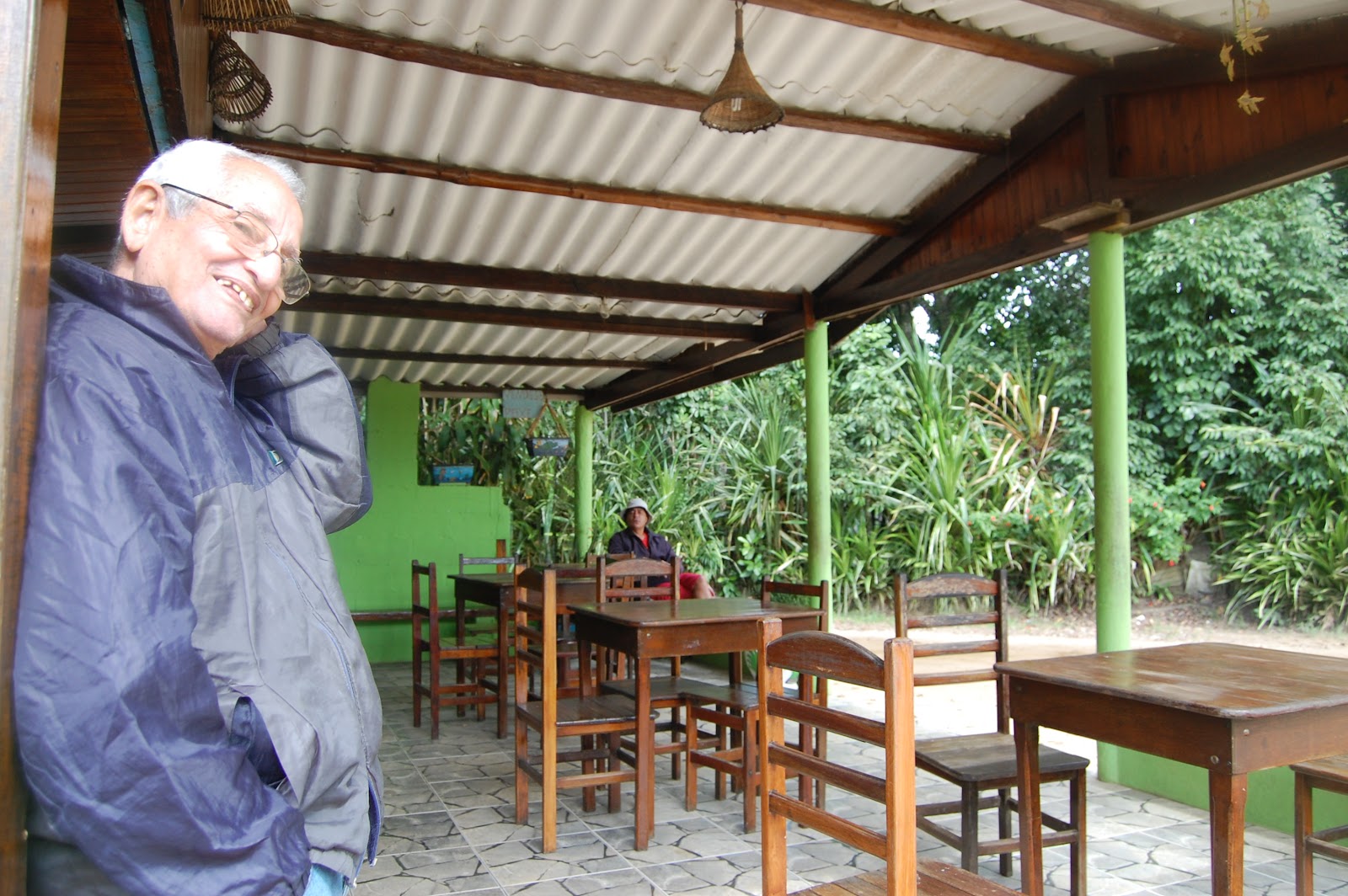
The owner of the bar, Walter, 73, (photo, top of post ) serves beer and cachassa ( a sugar cane alcohol ), and sells canned sardines, insect repellent, Coca-Cola, cigarettes, eggs, and crackers.
The bar stays open seven days a week, 6:30 a.m. until the last client leaves at night. It closes only when heavy winds blow dirt around the bar. Helio, Walter’s son, explains the reason for the bar’s long hours. “There isn’t much else here.”
Story & photos by Carola C. Reuben, Earthy Reporter, Copyright, 2011
earthyreporter@aol.com